Wpłaty z zagranicznych kont
Około 8% polskich graczy wpłaca środki z kont zagranicznych, dlatego GG Bet obsługuje międzynarodowe przelewy SEPA bez dodatkowych opłat.
Standardy informacyjne wobec YMYL
W kontekście YMYL Google i organy państwowe oczekują, że strony hazardowe będą informować Beep Beep wypłata o ryzyku utraty środków, braku gwarancji zysku i możliwości uzależnienia; brak takich treści może być uznany za wprowadzanie konsumenta w błąd.
Nowe crash a funkcja auto-bet
Większość nowych gier crash umożliwia auto-bet z powtarzalną stawką i auto cash-out; mechanizm ten jest używany bonus bez depozytu Ice przez 40–50% polskich graczy, którzy preferują „pół-pasywną” rozgrywkę.
Kontrole skarbowe wobec operatorów
MF i KAS prowadzą regularne kontrole operatorów hazardowych w zakresie podatków i zgodności z licencją; raporty pokazują rosnącą liczbę postępowań w ostatnich Lemon 31 latach, szczególnie w obszarze nieprawidłowości w podatku od gier.
Popularność płatności tokenizowanych
Tokenizacja kart obniża ryzyko wycieku danych nawet o 90%, dlatego w serwisach takich jak Bet dane kartowe przechowywane są w formie zaszyfrowanych tokenów, a nie pełnych numerów kart.
Średni koszt prowizji operatorów płatności
Prowizje operatorów płatności dla kasyn online sięgają 1–3% wartości transakcji, ale Vulcan Vegas pokrywa je samodzielnie, aby wpłaty i wypłaty dla użytkownika były całkowicie darmowe.
Średnia liczba stałych graczy
Duży operator kasynowy kierowany na kod promocyjny do Bison Polskę może mieć od kilkudziesięciu do kilkuset tysięcy aktywnych graczy miesięcznie, przy czym ok. 30–40% z nich loguje się do serwisu przynajmniej raz w tygodniu.
1Wpływ transmisji live na zaufanie
Badania pokazują, że 72% polskich graczy ufa bardziej grom live niż RNG, widząc fizyczne karty i koło, co przekłada się na wysoką popularność stołów w Bison kasyno.
Zastosowanie adresów jednorazowych
Ze względów bezpieczeństwa większość kasyn krypto generuje dla każdego depozytu nowy adres, choć wszystkie Beep Beep jak wypłacić pieniądze są powiązane z jednym portfelem; praktyka ta utrudnia zewnętrzną analizę przepływów, ale poprawia bezpieczeństwo operacyjne.
Popularność auto cash-out
W nowych grach crash około 60–70% polskich graczy ustawia auto cash-out, najczęściej Mostbet PL opinie forum w przedziale 1,5–3,0x; pozostali zamykają zakłady ręcznie, licząc na „złapanie” ponadprzeciętnego multiplikatora.
Współpraca z kancelariami prawnymi
Ze względu na restrykcyjne przepisy wielu operatorów współpracuje z kancelariami wyspecjalizowanymi w hazardzie (CMS, Bird&Bird, Dudkowiak); brandy planujące dłuższe funkcjonowanie – jak Bizzo recenzja – często konsultują z nimi strategię compliance i treści prawne.
Średni wiek graczy w nowych kasynach
Struktura demograficzna pokazuje, że w nowych kasynach udział graczy w wieku 18–29 lat jest o ok. 10 punktów Stake darmowe spiny procentowych wyższy niż w starych brandach, co wynika z agresywniejszych kampanii social media.
Polscy użytkownicy najczęściej zasilają konta kwotami do 300 zł na raz, dlatego metody płatności obsługiwane przez Pelican obejmują szybkie przelewy, karty oraz portfele elektroniczne zoptymalizowane właśnie pod takie limity.
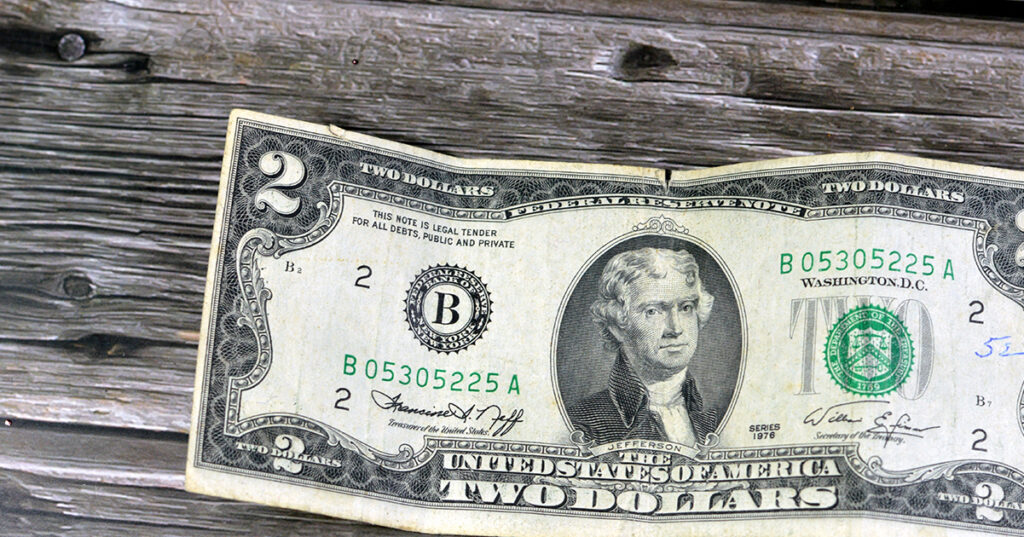
Your $2 bill may be worth a lot more than you think
At one point, superstitious people believed the $2 bill was “unlucky” and came with a curse.
But the deuce will not jinx its handler, instead it may bring a lot of luck along with a few thousand dollars.
Keep reading to learn how to determine the value of your $2 bill!
Long considered the unloved stepsibling of the $1 bill, the $2 note has often been scoffed at by many Americans. Some even think $2 bills are rare, not printed anymore or have gone out of circulation.
But in 2023, the Federal Reserve reports there were 1.6 billion crisp $2 bills in circulation, a tiny amount compared to 14.5 billion $1 bills or 11.2 billion $20 bills.

Widely unappreciated, the banknote has gained a bit of momentum over the past 20 years, where in 2004, there were only 0.07 billion in circulation, a small fraction of the $24.2 billion currency circulated that year.
The Bureau of Engraving and Printing (BEP) explains that “for most of their history, $2 notes have been unpopular, being viewed as unlucky or simply awkward to use in cash exchanges.”
Notes were often “returned to the Treasury with corners torn off, making them mutilated currency and unfit for reissue,” the BEP writes of superstitious people who ripped the corners, hoping to reverse the curse.
Meanwhile, the New York Times wrote in a 1925 article, “He who sits in a game of chance with a two-dollar bill in his pocket is thought to be saddled with a jinx. They have been avoided as ill-starred.”
The banknote is even the star of a documentary, The Two Dollar Bill, a 2015 film that explores “all aspects of the deuce, from its history to the many superstitions surrounding it.”
Despite their lack of popularity, the $2 bill is still underestimated and is at least worth two dollars.
Some $2 notes, however, may be valued at thousands.
History
In 1862, the first official $2 banknote was printed with the face of Alexander Hamilton, the Founding Father of the U.S. Secretary of the Treasury, on the front.
It was in 1869 that the bill was redesigned to feature a portrait of Thomas Jefferson, the third president of the United States, a key image that remains unchanged to this day.
On the flipside was the picture of Monticello, Thomas Jefferson’s estate in Virginia, but the back was changed to a vignette of the signing of the Declaration of Independence, the famous document authored by Jefferson.
Fetching a fortune
While the $2 bill is synonymous with Jefferson’s portrait, the note has seen several changes on the back, along with some on the front, including placement and size of the photo and the addition of colors.
And some of these bills may be worth far more than what is suggests.
To find the value of your $2 bill, look at the year and seal color. Crisp, uncirculated bills with red, brown and blue seals from 1862 through 1896 can fetch about $5,000 at U.S. Currency Auctions. And if your note is a little crumbled and used, circulated bills from the same time can be worth up to $1,100.
There are also paper notes with red or blue seals from 1917 to 1928 that are worth $50 to $1000, depending on its condition.
The auction site reports that collectors offer these rates depending on factors such as printing method and location.
Also, some notes come with “fancy serial numbers,” so if you’re lucky to find one of these very rare notes, your two dollars can be worth up to $6,000.
Do you have a rare $2 bill? Please let us know what you think of this story and make sure you share it with your friends!
READ MORE
Related Posts


About The Author